
Do Restaurant Chatbots Actually Help? Where They Work
A guest messages your restaurant at 9pm asking if you have a table for four tomorrow, and nobody picks up the phone until morning. That gap between a question and an answer is where restaurant chatbots either earn their keep or quietly waste your money.
Restaurant chatbots help most with routine, predictable requests, such as hours, menu questions, simple bookings and order status, but they struggle with complaints, allergies and anything needing judgement. The gap between those two categories is where owners either save real staff time or create new frustration.
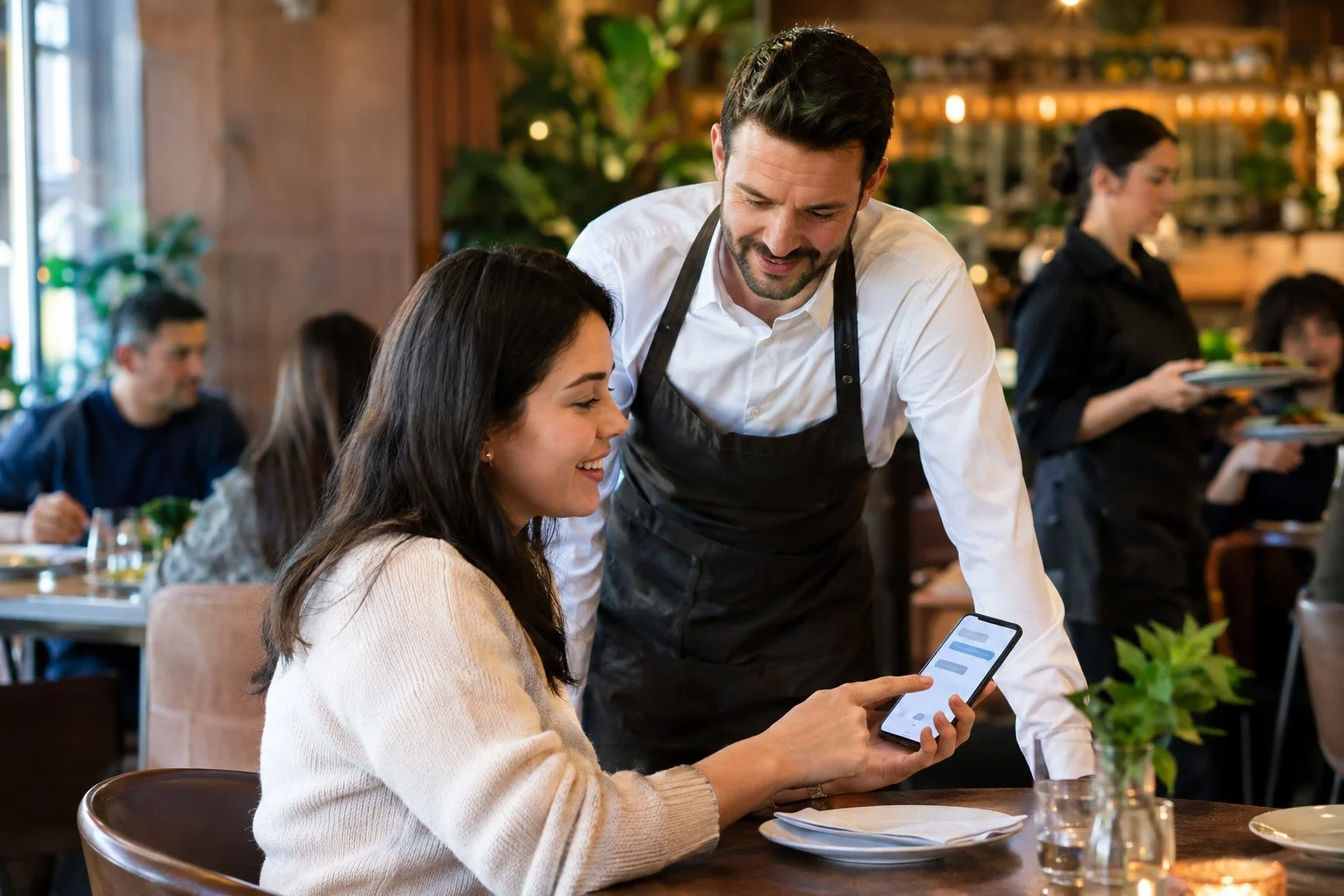
This article looks at the guest's actual path, from the first question to a completed booking, order or handover to staff, and shows where automation fits and where it doesn't.
Key Takeaways
Chatbots handle repetitive questions and simple bookings well, but struggle with complaints, allergies and complex orders.
The right test is completed bookings, accurate orders and staff time saved, not how many chats the bot answers.
Start small with an FAQ or booking bot, connect it to your existing systems, and keep a clear path to a human.
Which Restaurant Tasks Can Chatbots Handle Well?
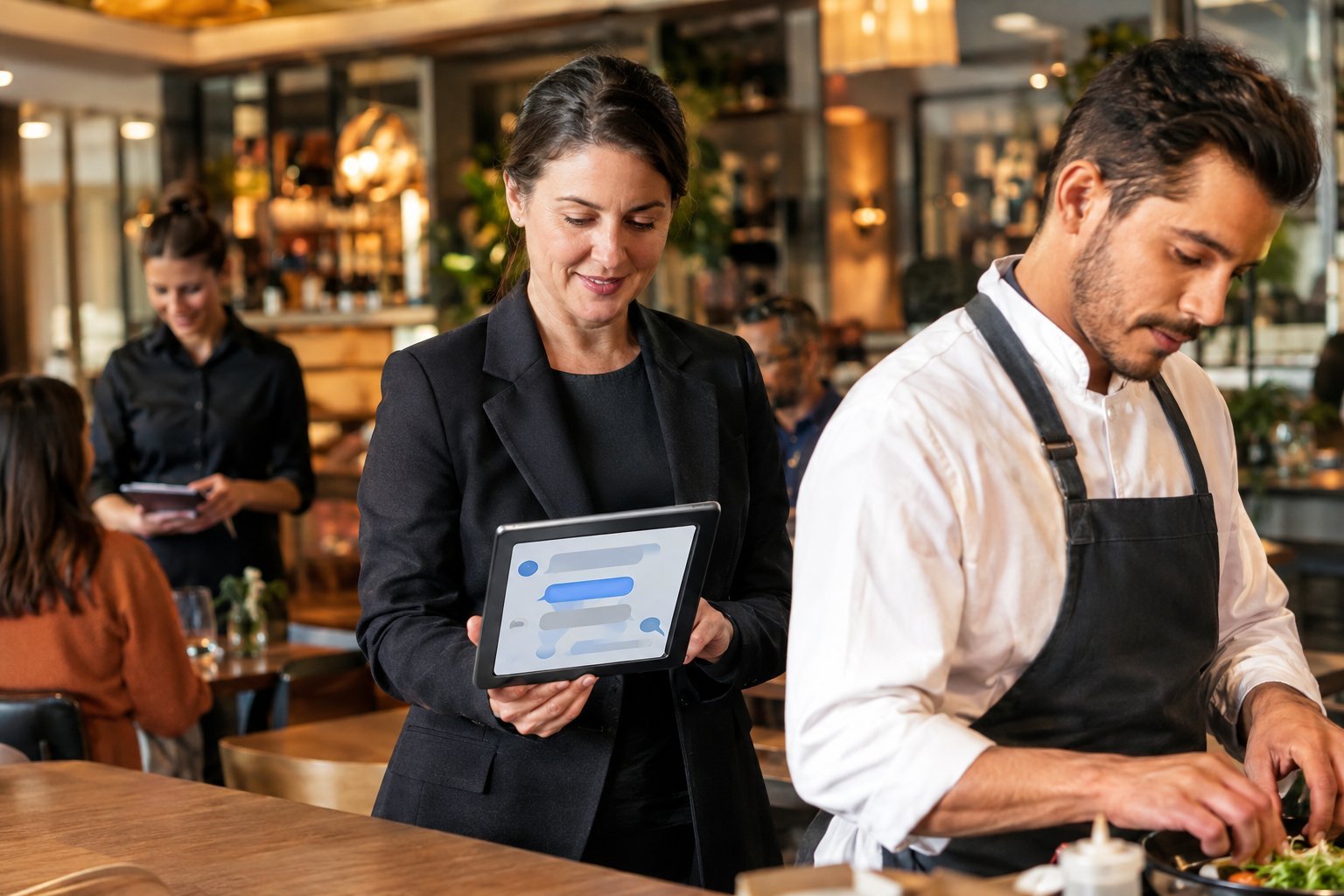
Restaurant chatbots do best with high-volume, low-complexity tasks: answering the same ten questions customers ask every day, taking straightforward bookings, and giving order updates without tying up a staff member. Chatbots for restaurants work less well once a request needs judgement, so the goal is matching the task to the tool rather than automating everything in sight.
Can They Answer Menu Questions and Take Orders?
An online menu paired with a chatbot handles basic questions well: opening hours, parking, dietary options and today's specials. These are the questions restaurants field dozens of times a day, and a bot answers instantly without a server stepping away from the floor.
Online ordering through a chatbot works best for simple menus. Restaurants with under 40 items and few modifiers see accuracy rates of 80-92% for standard orders, though this drops to 50-65% once customers start asking for multiple changes to a single item, according to FoxiFood's assessment of restaurant chatbot performance. Complex customisation is still better handled by a server or a traditional ordering interface.
Can They Manage Reservations and Waitlists?
Chatbots in restaurants handle straightforward table bookings quickly and reliably. A guest asking for "a table for four, Saturday at 7pm" gets checked availability, a confirmation and a reminder, often in under a minute and with no staff time spent.
This breaks down once requests get specific: a particular table, a large party with special seating needs, or an event booking. Those still need a human who understands your floor plan and can make judgement calls.
Can They Provide Useful Order Updates?
Order tracking is one of the clearest wins. "Where is my food?" is the most common question after checkout, and a chatbot linked to your ordering system answers it without a phone call. Status updates delivered this way can cut post-order phone calls by 30-50%, per the same FoxiFood analysis of restaurant chatbot use cases.
Are Internal Staff Tasks a Good Fit?
Restaurant chatbots also support work behind the scenes. Beyond guest-facing tasks, they can help with employee scheduling and staff training, answering shift questions or walking new hires through basic procedures, according to Botpress's guide to restaurant chatbot capabilities. This frees managers from repeating the same instructions to every new starter.
When Do the Benefits Outweigh the Costs?
The benefits outweigh the costs when a chatbot handles enough repetitive volume to free up meaningful staff time or capture sales you'd otherwise lose after hours. Below that threshold, the subscription and setup cost rarely pays for itself.
Where Do Faster Replies Save Staff Time?
Faster replies save the most time when your restaurant gets a steady stream of repeat questions. A restaurant fielding 30 repetitive inquiries daily through website chat and messaging apps can save 45-90 minutes of staff time each day by automating those replies, work out to roughly 400-420 USD in net monthly savings once the chatbot's own cost is subtracted, based on figures from FoxiFood's ROI breakdown for restaurant chatbots.
After-hours messages matter too. Restaurants report that 25-35% of online inquiries arrive outside opening hours, and capturing even a portion of those as bookings or orders adds revenue that would otherwise be lost, the same source notes.
Do Recommendations Increase Sales Without Annoying Guests?
Personalised recommendations can lift order size when they're based on real preferences, not generic upselling. A chatbot that remembers a guest ordered a vegetarian dish last time and suggests something similar builds customer engagement rather than feeling like a sales script.
The line is thin. Guests who feel pushed toward add-ons they didn't ask for disengage quickly, so recommendations work best when they're genuinely useful, not just another prompt to spend more.
How Should Restaurants Measure Return on Investment?
Measure return by tracking completed bookings, accurate orders, staff hours saved and customer satisfaction, not by counting how many conversations the bot handled. A high chat volume means nothing if guests still end up calling the restaurant anyway.
Watch your escalation rate closely. A chatbot handing off more than a quarter of conversations to a human suggests it's set up for tasks beyond its depth, a benchmark reflected in FoxiFood's monitoring guidance for restaurant chatbots. Treat any vendor's own performance claims as a starting point to test against your own numbers, not a guaranteed outcome.
Where Can a Chatbot Make Service Worse?
A chatbot makes service worse when it's asked to handle situations needing empathy, accurate judgement or complex problem-solving, and instead gives a scripted, unhelpful reply. The restaurant operations risk here is real: a bad chatbot interaction can do more damage than no chatbot at all.
Why Are Allergies and Complaints Better Handled by Staff?
Allergy questions carry health consequences, and a wrong answer from a bot is a serious risk. Chatbots should stick to confirming basic allergen information from your menu and hand off anything more specific to a trained member of staff with a clear disclaimer.
Complaints need the same care. Customers who meet a chatbot during a complaint often feel worse about the business than if they'd reached nobody at all, with one estimate putting that figure at 68%, according to FoxiFood's review of chatbot failure points. A chatbot can acknowledge frustration and capture details, but resolving the issue is a job for a manager, not a script.
What Happens When Menu or Availability Data Is Wrong?
Outdated menu or stock data breaks trust fast. If your chatbot offers an item you've already sold out of, or quotes a price you changed last week, guests notice immediately and the bot looks careless rather than helpful.
This is where ai-powered chatbots depend heavily on good connections to your actual systems. A bot that doesn't sync with your point-of-sale menu in real time will eventually sell something you can't deliver.
When Does a Human Handover Become Essential?
A human handover becomes essential whenever a conversation involves negative sentiment, an unusual request, or anything outside the bot's defined scope. Conversational ai built on natural language processing (NLP) and machine learning has improved at understanding free-form questions, but it still works within limits, and multilingual support in particular varies between tools.
Every chatbot interaction needs a visible, working way to reach a person. Bots that trap guests in a loop with no escape generate the strongest negative reactions of any failure mode, as highlighted in Finitless's review of restaurant chatbot implementation challenges.
How Do You Choose and Test the Right Setup?
Choose the simplest tool that solves your actual bottleneck, then test it against your own booking, ordering and payment systems before expanding it. The right setup for a 30-cover café looks nothing like the right setup for a multi-site group.
Should You Start with a Simple FAQ Bot or an AI Assistant?
Start with a simple FAQ bot if your main problem is repetitive questions about hours, location or dietary options. These cost little, set up in hours rather than weeks, and give you a low-risk way to learn what guests actually ask.
Move toward ai chatbots for restaurants, or a fuller ai chatbot for restaurants setup, only once the FAQ bot is stable and you have genuine order or reservation volume to justify the extra cost and complexity.
Which Booking, Ordering and Payment Connections Matter?
POS integration decides whether a chatbot reduces work or creates more of it. A bot that can't connect directly to your point-of-sale system forces staff to re-enter every chatbot order by hand, which defeats the purpose.
The connections worth checking before you sign anything:
Booking platforms such as OpenTable or Resy, so chatbot reservations sync with your existing floor plan and don't create double-bookings
POS systems such as Lightspeed, so orders and menu changes flow through without manual re-entry
Delivery platforms such as DoorDash or Uber Eats, if the bot needs to pass orders through to third-party delivery
Payment processing, so guests can pay through the bot without a separate step at the till
Ask for a live demo using your specific systems before committing. A vendor that can't show the connection working isn't ready for your restaurant.
How Can You Run a Low-Cost Trial and Check Its Results?
Run a two-week trial on a single channel, such as your website chat widget or WhatsApp, before rolling out more widely. Track completed bookings, order accuracy and how often the bot hands off to a human.
If you plan to collect emails through the chatbot, keep that sign-up separate and optional from the booking or order itself. Make the first email useful, such as confirming a reservation or sharing parking details, rather than a promotional push, so subscribers stay engaged rather than unsubscribing after one message. For restaurants wanting a wider look at digital presence alongside chatbots, a guide to AI recommendations for restaurant websites covers how guests find you before they ever reach a chat window.
Start with the Tasks Your Guests Already Ask About
The fastest way to judge a restaurant chatbot is to look at your own inbox and phone log first. Spend two weeks tracking what guests actually ask: hours, bookings, dietary questions, order status or complaints. If FAQ and order-status questions make up less than 40% of what you get, a chatbot may not earn its cost.
Build from your busiest channel outward. Most restaurants see the highest engagement on WhatsApp, followed by website chat, according to Finitless's implementation guide for restaurant chatbots. Start there, nail one use case, such as answering hours or taking bookings, and only add ordering or payment once that first layer runs smoothly. A chatbot that does one thing reliably beats one that does five things badly.
Conclusion
Restaurant chatbots earn their place when they take on repetitive, predictable work: answering common questions, confirming bookings, and giving order updates without pulling staff away from guests in the room. They lose their value, and sometimes damage it, when they're pushed into complaints, allergy questions or complex customisation that need a person's judgement.
Judge any chatbot by the guest's actual path, from question to booking, order or handover, and by whether it saves real staff time and keeps guests satisfied. Start small, connect it properly to your booking and POS systems, and keep a visible route to a human for anything the bot can't handle well.
Frequently Asked Questions
Are restaurant chatbots effective for small restaurants?
Yes, for small restaurants with 20 or more repetitive daily inquiries, a basic FAQ bot often delivers the clearest return, since setup costs stay low and the task is simple. Small operators with fewer repeat questions may find the cost harder to justify until volume grows.
Can a chatbot take food orders accurately?
A chatbot handles standard orders well, with accuracy around 80-92% for simple menus with few modifiers, according to FoxiFood's cost-benefit figures for ordering bots. Accuracy drops sharply once customers ask for multiple changes to a single item, so complex menus are often better served by a traditional ordering interface.
Do customers prefer a chatbot or a member of staff?
Guests generally prefer a chatbot for quick, routine tasks like checking hours or booking a table, but want a human for complaints or unusual requests. The preference shifts with the complexity of the task rather than being fixed either way.
How much does a restaurant chatbot cost?
A basic FAQ bot can cost as little as free up to 50 USD a month, while ordering bots range from 50-300 USD and fuller AI conversational tools run from 200 to over 1,000 USD monthly, based on figures from FoxiFood's breakdown of chatbot pricing tiers. Costs rise with setup time and the complexity of tasks the bot handles.
What is the best AI tool for a restaurant?
The right tool depends on your biggest bottleneck, but a simple FAQ bot suits most independent restaurants starting out, since it handles the highest-volume, lowest-risk task first. Restaurants with heavier order or reservation volume across multiple locations may later justify a fuller AI conversational assistant once the simpler bot proves its worth.
